Help! My loved one refuses to see a doctor

There are many reasons why some people don’t want to see a health care provider — but scheduling a health assessment at home may make them feel more comfortable.
The information in this article is for educational purposes only and is not intended to replace medical advice from your doctor.
Health care providers offer important lifesaving care and advice. But not everyone feels comfortable seeing them.
There could be lots of reasons for this. Some may have received a wrong diagnosis in the past, had an encounter with a provider they didn’t like, or received advice they didn’t agree with. Or they may even be afraid of what they may learn about their health. This may be how your loved one feels.
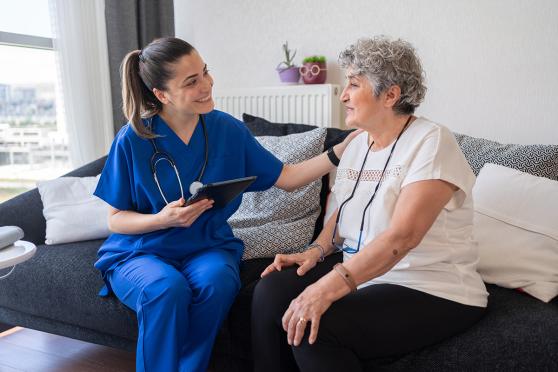
If your loved one is refusing to go to a provider’s office, there’s another option to consider. Schedule a checkup in the comfort of their own home, with you nearby.
Here’s everything you need to know about in-home health and wellness assessments — and how they can make getting needed care easier and more comfortable.

Your plan includes a yearly at-home health assessment — at no added cost.
8 a.m. to 11 p.m. ET M–F; 9 a.m. to 5 p.m. ET Sat. (TTY: 711)
The benefits of an in-home health assessment
These visits give health care providers a different perspective on their patients. It’s always helpful — and more relaxed — to see them in the comfort of their own home, says Sharon Brangman, MD, a doctor specializing in geriatrics at SUNY Upstate Medical Center.
“When they come into the office, they’re dressed up and on their best behavior,” she says. “It’s an artificial setting.” But in-home visits are more casual and comfortable. And this personal touch can make all the difference for a loved one who’s reluctant to get checkups.
In-home health visits are a gentle, easy way to get your loved one back on track. What’s more, the clinician who comes to your home will send a full report back to their primary care physician.
It couldn’t be simpler: No traffic and no long waits at the doctor’s office. In a 2023 survey, 75% of participants said they’d be game for an in-home wellness visit or physical.
4 reasons your loved one may skip doctor’s visits — and how in-home visits can help
When your loved one insists that they’re not going to the doctor’s office, let them know how easy it is for a clinician to come to them.
Here are some of the most common excuses for not seeing a healthcare provider, plus ways an in-home visit can help your loved one stay healthy, strong, and independent.
1. “Getting to the doctor is time consuming.”
As important as regular visits with your primary care provider are, it’s not always easy to see them in their office. In fact, the average wait time for an appointment is 21 days. While home health assessments can’t replace these crucial interactions, they play a key role in ensuring your loved one is staying on top of their health and getting the care they need.
The in-home visit solution: Scheduling is easy. You can book an appointment online or you can call 877-302-3672. And depending on their health plan, your loved one’s care manager may also be able to help you schedule. You won’t spend time traveling either. That’s great news for people who rely on others to drive them — or who need to take a long bus trip to get to their appointment.
2. “Doctor visits cost too much.”
For many people, going to the doctor is just too expensive. A recent Gallup poll found that 38% of Americans skipped regular medical care because of the cost. Even more worrying is that 27% went without checkups for serious conditions. But studies show that regular visits with your family healthcare provider are linked to less disease and a longer life.
The in-home visit solution: A yearly in-home health assessment is offered at no additional cost to you, thanks to your loved one’s health plan. Simply reach out to their plan’s care manager. (Have their member ID card handy.)
3. “The doctor always seems too rushed to listen to me.”
There’s a reason for that: The number of Americans is growing faster than the number of doctors to care for them, leading to a shortage of primary care physicians. That makes doctors super busy and means that they have less time to spend with each patient. The average patient gets just 18 minutes per visit. That’s not always long enough to address all of a patient’s questions and concerns.
The in-home visit solution: The clinician will spend more time with you, often up to an hour. Remember, in-home health assessments are designed to support the care you receive from your PCP. Your loved one won’t feel rushed asking questions. “These visits give us a chance to talk about screening and preventive care, when issues are easier to treat,” says Diane Chapman, DNP, a nurse practitioner in Salt Lake City.
4. “I'm healthy and don’t need to see a doctor.”
Your loved one may feel as “strong as an ox,” never miss a day of work or activities, and have a parent who lived to be 100. If these are their excuses for skipping doctor’s visits, let them know they could be missing something important. After all, you can have health problems such as high blood pressure, high blood sugar, or high cholesterol without even knowing it.
The in-home visit solution: When the clinician visits your home, they can uncover hidden problems that can often be treated easily — and early.
“Our goal is to help you have the highest quality of life and maintain your independence for as long as possible,” says Dr. Brangman. “And the best way to do that is to have an idea of any health issues that may be on the horizon — and prevent problems that would impact your independence. With in-home health visits, you can maintain your quality of life or even improve it.”
An in-home health assessment might be the perfect way to get your loved one back on track health-wise. And once they have their first appointment, they may realize how easy, convenient, and helpful it is — and want to book one again next year.
See our sources:
Consumer health behavior and the COVID-19 pandemic: What have we learned? PwC
Appointment wait times increase across specialties, but not in family medicine: American Academy of Family Physicians
Record high in U.S. put off medical care due to cost in 2022: Gallup
Association of primary care physician supply with population mortality in the United States, 2005-2015: JAMA Internal Medicine
Continuity of care with doctors—a matter of life and death? A systematic review of continuity of care and mortality: BMJ Open
Measuring primary care exam length using electronic health record data: Medical Care
Comprehensive health assessment: Matrix Medical Network
Y0114_25_3015278_0013_I_C 3/13/25 1080924MUMENMUB 0013